Troubleshooting
Your two-step funnel is losing people on step two
Two hundred people hand over an email on step one. Forty one finish step two and book. The leak is not step one, and it is the most fixable problem in the whole funnel.
It is a Tuesday and the opt-in report finally looks healthy. Two hundred people hit step one of your funnel this week and handed over an email address. Then you scroll down to the number that actually pays the bills, the one for people who finished step two and booked the call, and it says forty one. One hundred and fifty nine people raised their hand, said yes, started the process, and walked away in the ten seconds it took them to reach the second page.
The reflex is to blame step one. Rewrite the headline, swap the lead magnet, test a new button colour. But step one is doing its job. Two hundred opt-ins from a single local offer is a page that works. The money is leaking somewhere people rarely look, in the gap between the first yes and the second, and it leaks fast because the people falling out of the funnel already told you they were interested.
A two-step funnel that loses people on step two is one of the most fixable problems in GoHighLevel, because the drop is concentrated on one page you can measure and one page you can rebuild in an afternoon. This guide walks the two-step chain in order, shows you how to read exactly where the drop sits, puts a dollar figure on it, and lists the leaks on step two in the order they usually cost you the most. If you want the full machine this page sits inside first, the anatomy of the GoHighLevel funnel builder lays it out end to end.
What a two-step funnel is, and why step two exists at all
A two-step funnel asks for the smallest possible thing first, then asks for the real thing once the visitor has already said yes once. Step one takes an email, sometimes only a first name. Step two is where the weight lives: a phone number, two or three qualifying questions, a time picked off a calendar, now and then a card. The split is deliberate, and it is not a GoHighLevel quirk. It is one of the oldest moves in persuasion.
Get a person to agree to something tiny and the next yes comes easier, because people prefer to act in line with what they have already done. Robert Cialdini files it under commitment and consistency. In a funnel it means a visitor who has already typed an email is measurably more willing to answer the next question than a cold visitor meeting that same question on one long form. That is the entire reason step two is allowed to ask for more. The first yes bought you the right to ask.
In GoHighLevel a two-step funnel is usually two funnel steps: an opt-in page with a short form whose action redirects to a second page, or one page with a two-stage form that swaps the first fields for the second after a click. Either way the contact is created the instant step one is submitted. Hold onto that detail, because it is what makes this leak survivable. Even the people who quit on step two are already in your database. You can reach them. We will come back to that when someone tries to argue you should just retarget your way out of the problem.
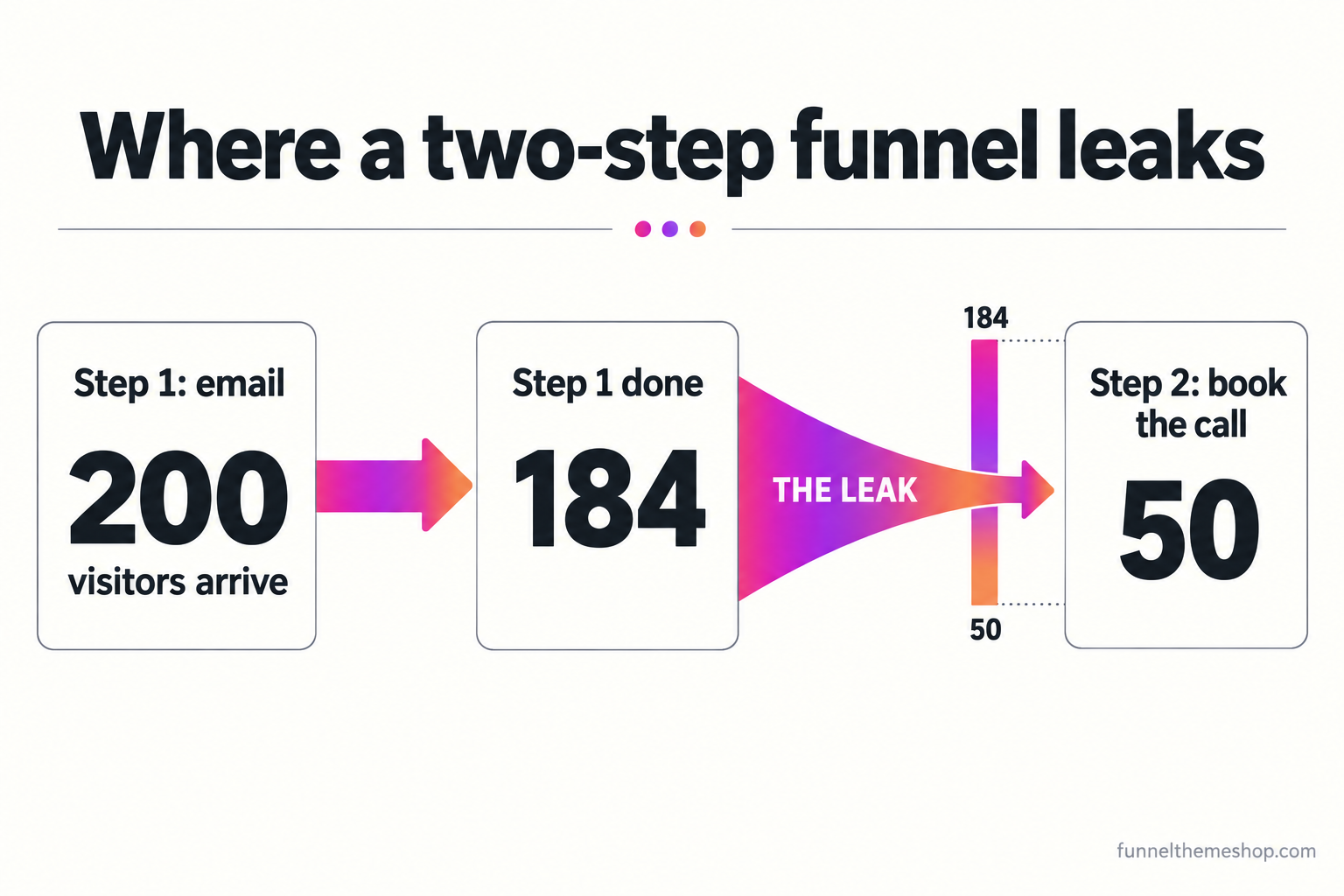
Step two is the first moment the funnel asks the visitor to spend something that costs more than ten seconds. A phone number they know means a call. A calendar they have to pick a real time from. Three questions about their situation. Anything clumsy here, a page that looks like a different website, a reason that was never given, a form that fights their thumb, turns the yes back into a maybe, and the maybe into a closed tab.
Read the drop before you touch anything
Before you change a single field, get the two numbers that tell you whether you even have a step-two problem. Guessing here is how people spend a weekend rebuilding the page that was never broken.
Open the funnel in GoHighLevel under Funnels and Websites, then open the stats tab. It reports views and submissions for each step. You want two ratios out of it. The first is step-one completion: step-one submissions divided by step-one views, which tells you how the opt-in is doing. The second is the one that matters here: step-two completion, which is the real conversions divided by the number of people who actually reached step two.
If step one converts at a healthy clip and step two converts far lower off the people who reach it, the leak is on step two and the rest of this guide is written for you. If step two is fine and almost nobody reaches it in the first place, your problem is upstream on the opt-in itself, and the traffic-but-no-opt-ins diagnosis is the one to read instead. Same funnel, different leak, completely different fix.
One trap before you trust the numbers. If step two is a separate page and you are reading raw views, a visitor who refreshes or wanders back later inflates the denominator and makes step two look worse than it is. And if the contact is created on step one but the step-two form is a different form that was never tied to the same contact, your analytics can show a clean drop that is really two forms that never got introduced to each other. That second case is not a conversion problem at all. It is a plumbing problem, and it looks exactly like a form that submits but never fires its workflow. Rule it out before you blame the copy.
What the gap is actually costing you
Put a number on the leak before you decide how hard to work on it. The arithmetic settles the argument fast, and it only needs your own figures.
Say step one brings you 200 opt-ins a month, an ordinary month for a single local offer. Your step two completes at 25%, so 50 of those 200 actually book. Lift step two to 55%, which is not heroic for a clean booking page, and the same 200 opt-ins now produce 110 booked calls. You did not buy one extra click. You found 60 booked calls a month in traffic you were already paying for.
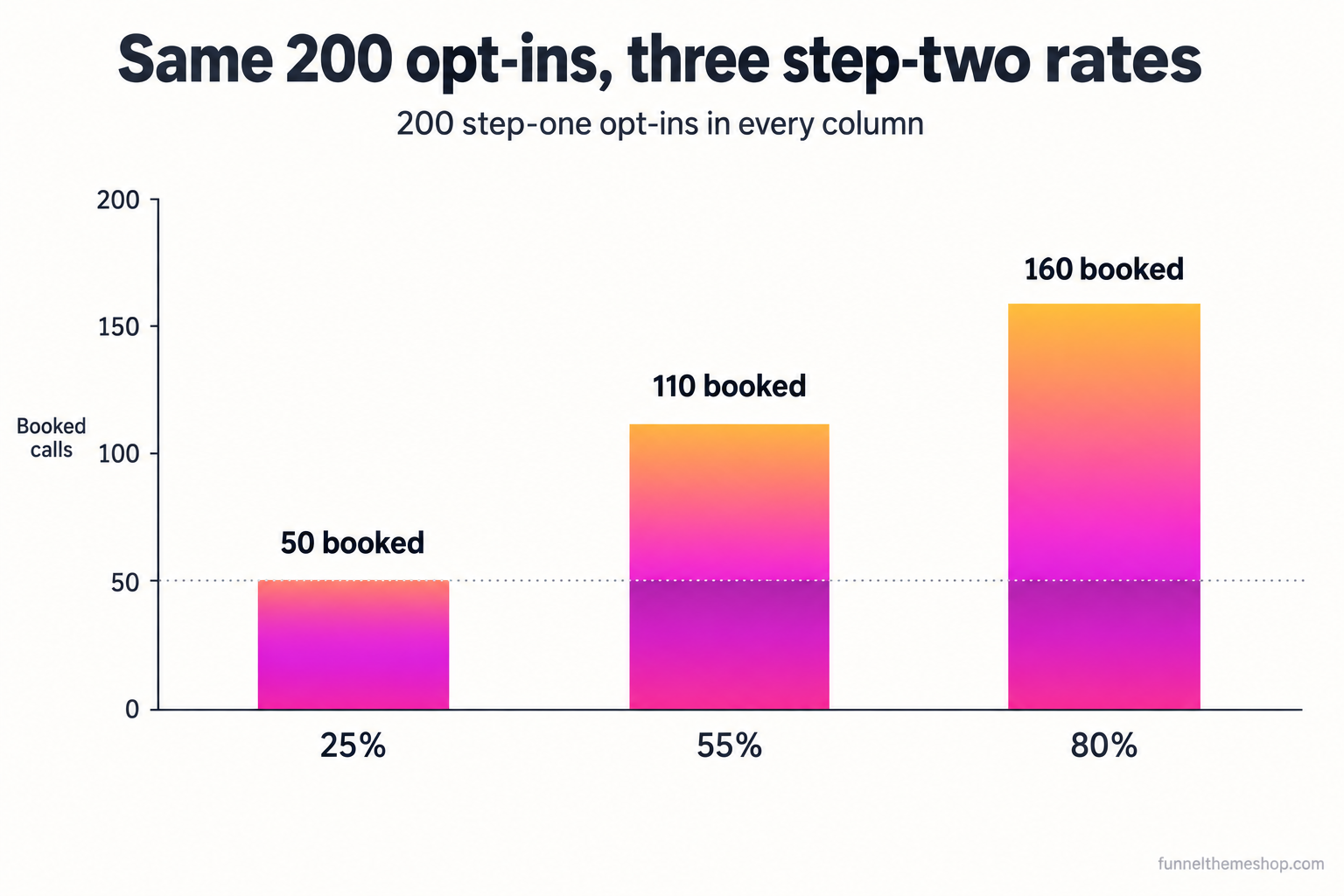
Now put a rough value on a booked call. Say one in three booked calls becomes a customer worth 600 dollars to you. At 25% step-two completion that funnel is worth about 10,000 dollars a month in new customers. At 55% it is worth about 22,000. The assumptions are yours, and you should swap in your real close rate and your real customer value, but the direction never changes. The cheapest growth in the whole funnel is almost always the second page, not the next ad.
There is a reason the second step is where the asking gets expensive, and it is worth reading twice. Baymard Institute, which has spent years watching people abandon purchases, found that the average checkout flow carries 11.3 form fields across 5.1 steps, and that the number of fields matters more than the number of steps (confirmed this run via search snippet from baymard.com/research-articles/checkout-flow-average-form-fields, not independently fetched). That finding is the whole thesis of this article. Splitting a form into two steps does not cost you people. Piling fields onto either step does. A two-step funnel bleeds on step two not because it is step two, but because step two is where people dump every field they ever wished they could ask.
The same researchers put the average documented cart abandonment rate at 70.22%, averaged across roughly 50 separate studies (also snippet-confirmed this run, from baymard.com/lists/cart-abandonment-rate). That is ecommerce checkout, not an opt-in funnel, so do not borrow it as your benchmark. Borrow it as the ceiling of what a heavy second step costs when nobody tends it. Seven in ten gone, after they had already decided to buy.
The five leaks on step two, worst first
Almost every two-step funnel that bleeds on the second page is losing people to one of these five, and they are in rough order of how much damage they do. Work down the list. The moment the symptom matches yours, fix that one thing and watch that one number before you touch anything else. Changing five things at once teaches you nothing about which one worked.
1. Step two asks for everything the sales team ever wanted
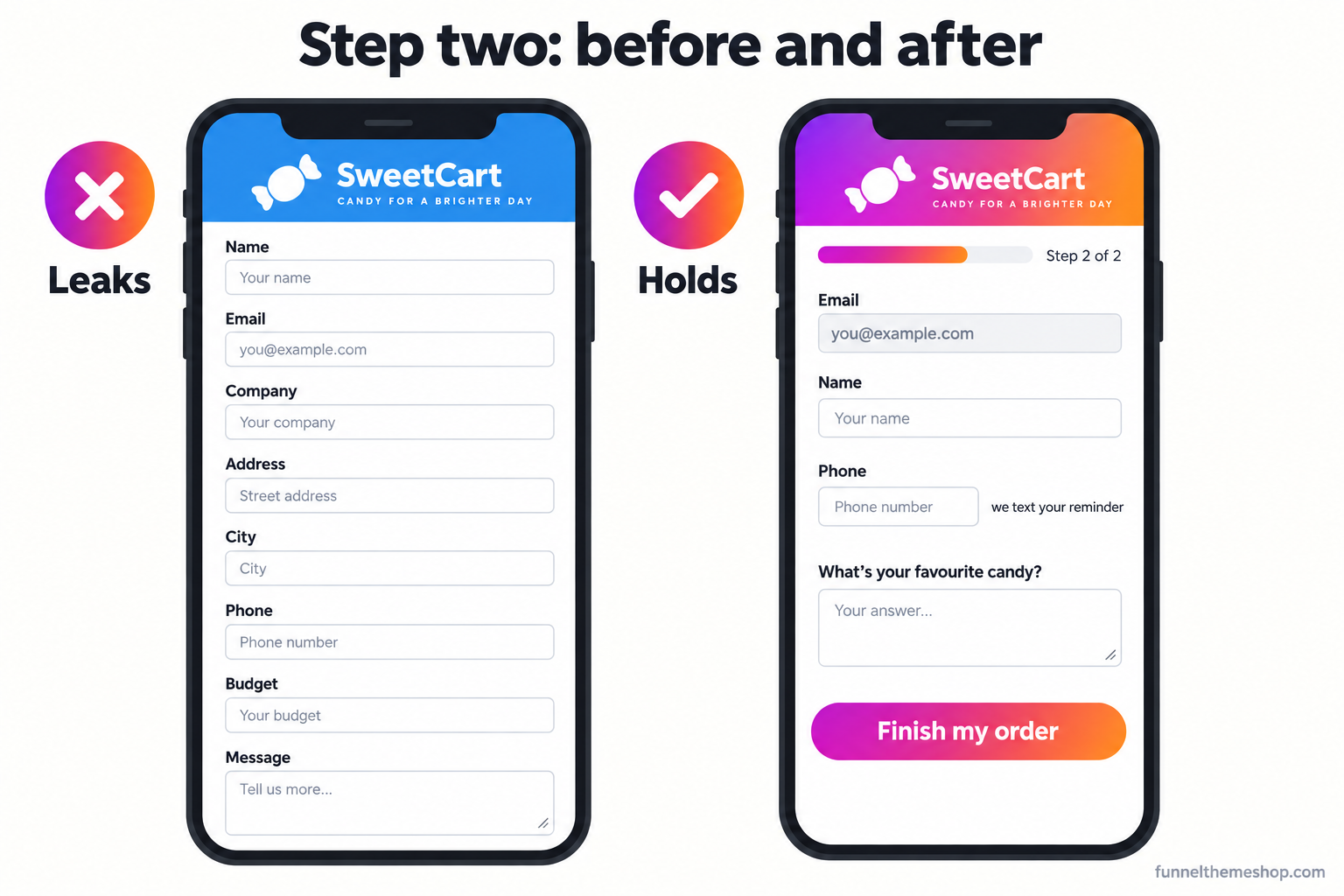
The symptom is a step-two completion rate far below step one, and a drop that is worst on mobile. The cause is almost always the same: step two became the place to collect the full address, the company name, a budget dropdown, a how-did-you-hear menu and a free-text message box, because every one of those felt useful to someone. Each field is a small reason to quit, and they add up faster than anyone expects.
The fix is a deletion, not a redesign. Cut step two down to the fields you will genuinely use before the first conversation: a name, a phone number, and the single question that decides whether you can even help this person. Everything else can be asked on the call, when you have their attention and they have yours. This is the Baymard finding made practical. Fewer fields beats fewer steps every time, so thin the ask before you do anything cleverer.
2. Step two looks like a different website
The symptom is near-zero time on step two: people reach the page and vanish without touching a field. The cause is a break in continuity. The second page has a different header, a different colour, no sign of progress, and nothing that tells the visitor this is the same thing they just started. The worst version re-asks for the email they handed over on step one, which reads as either a bug or a bait and switch.
The fix is to make step two feel like the obvious next breath of step one. Carry the same brand, repeat the headline promise so they remember why they are here, and show a plain progress marker so they can see they are nearly done. Pre-fill the email from step one or drop that field entirely. Never ask twice for something the visitor already gave you. If the second page needs real structural work, the block-by-block layout in the high converting landing page breakdown applies to step two just as much as to step one.
3. The bigger ask arrives with no reason attached
The symptom is specific and it is a gift, because it points straight at the problem: people start step two, fill the first field, and abandon at the phone-number field in particular. The cause is that step one asked for an email with an implied reason, send me the thing, and step two asks for a phone number with no reason at all. An unexplained request for a phone number reads as a trap, and a wary visitor is right to treat it as one.
The fix costs one sentence. Put the reason next to the heaviest field, in plain words. Something like, we text a reminder the morning of your appointment so the slot does not go to waste. A stated reason turns a demand into a courtesy, and a courtesy gets answered. This is also where a booking funnel earns the kind of reliability our booking snapshots aim for, a target of around 70% no-show recovery, which only works if you were allowed to collect the number in the first place.
4. The calendar or payment lives on step two, and it breaks on a thumb
The symptom is a step-two completion rate that collapses on mobile while desktop stays fine. The cause is nearly always an embedded calendar or payment field that is simply unusable on a phone: tap targets too small to hit, a date picker built for a mouse, a card field that refuses to raise the numeric keypad. On a laptop you will never see it, which is exactly why it survives for months.
The fix starts with testing step two on a real phone rather than the desktop preview, and trying to finish it yourself with your thumb while timing how long it takes. If the calendar or payment widget fights you, swap it for the mobile-friendly version or move it. More than half of your traffic is probably on a phone, so a step that only works on desktop is a step that fails most of the people who reach it. The wider pattern of funnels that convert on desktop and die on mobile is worked through in the mobile funnel conversion guide.
5. The plumbing drops the contact between the two steps
The symptom is a clean drop in the stats paired with leads who swear they finished, or step-two submissions that never seem to reach a workflow or a notification. The cause is a wiring fault: the step-two form is not tied to the same contact the opt-in created, or the booking trigger is listening to the wrong step. The lead did finish. The system quietly lost them on the way through.
The fix is to confirm both forms write to the same contact record and that your booking or notification workflow fires on the step-two submission specifically, not on step one. Run one real lead through the whole chain and watch the contact, the tag and the notification all land. A drop caused by plumbing will not move an inch no matter how you rewrite the copy, so rule it out early. It is the same class of fault as a form that submits but never triggers its workflow, and it fools people into rebuilding a page that was converting all along.
One step or two? Pick the shape for your offer
Two steps is not automatically right. It earns its place when the real ask is heavy enough that softening it with a small first yes actually pays off. When the ask is already tiny, a second step is just one more door to close. Here is the rule of thumb by offer, and then the single line that decides it.
| Your offer | One step or two | Why |
|---|---|---|
| Free guide or checklist download | One step | The ask is already just an email. A second step adds friction and buys nothing. |
| Free quote or inspection for a local service | Two steps | Email first, then address and the one qualifying question. The split lifts completion on the heavier ask. |
| Booked call or demo | Two steps | Email first, then calendar and phone. The micro-yes makes the calendar feel earned rather than demanded. |
| High-ticket application | Two or three steps | The qualifying questions are the point. Stage them so no single screen reads like a job application. |
| Low-price tripwire or impulse buy | One step | Momentum is everything. Every extra screen is a place to reconsider the purchase. |
The deciding line is this. If removing the first step would make the real ask feel cold, keep both steps. If removing it would only get people to the real ask faster, you have a one-step funnel wearing a two-step costume, and the costume is costing you.
For the heaviest end of this, the staged qualification in a high-ticket application funnel shows how far the two-step idea stretches before it tips into too many doors. Booking-led offers, like the ones in the booking funnels category, are where the second step pays off most reliably.
The objections you are already making
"Two steps just adds friction. I should go one-step."
Friction and steps are not the same thing, and conflating them is how good funnels get flattened into worse ones. The Baymard finding again: the fields are the friction, not the steps. A one-step page with nine fields is far heavier than two pages with two fields each. If your two-step funnel is bleeding, thin step two before you collapse the whole funnel. Folding a bloated two-step page into a bloated one-step page is a lateral move that loses you the first-yes advantage and keeps every field that was doing the damage.
"I will just retarget the drop-offs and win them back."
You can, and you should, because those people are already contacts in your database the moment they cleared step one. But retargeting a leak is paying a second time to patch a page you could fix once for free. Spending ad budget to drag people back to a step-two page that loses one in two of them is pouring water into a bucket while ignoring the hole. Fix the page first. Then retarget whatever still slips through a page that is actually holding its own.
"Our page is fine. It must be the traffic."
Sometimes that is true, and this is the honest part of the article. If step one converts fine, and step two converts fine off the people who reach it, and the leads who do book turn out to be the wrong fit, then the funnel is not your problem at all. The mismatch is between your ad and your offer, and no snapshot, no rebuild and no audit of ours will fix a page that is converting the wrong people perfectly well. Fix the targeting and the offer first. A funnel can only ever convert the traffic it is handed. We would rather tell you that than sell you a rebuild you do not need.
Fix it this week
You do not need a project plan for this. You need an afternoon and the discipline to change one thing at a time. Work the list in order.
- Pull step-one and step-two completion from the funnel stats and write both numbers down. You cannot tell if a change helped without the before number.
- If step two is the low one, open it on a real phone and try to finish it yourself, timing how long it takes with your thumb.
- Cut step two to the fields you actually use before the first call. Everything else waits for the conversation.
- Add one line of reason next to the heaviest field, especially the phone number.
- Make step two look like step one, pre-fill or drop the email, and show a plain step 2 of 2 marker.
- Run one real lead through the whole chain, confirm the booking and the notification land, then watch the step-two number for a week before you change anything else.
Do that and the second page stops being the place your funnel quietly throws money away. Most two-step funnels do not need a new design. They need the second page to stop giving interested people reasons to leave.
Frequently asked
How do I see my step-two conversion rate in GoHighLevel?
Open the funnel under Funnels and Websites and look at the stats tab, which reports views and submissions for each step. Divide step-two submissions by the number of people who reached step two. Compare that to step-one completion. If step two is much lower off the people who get there, the leak is on the second page.
Is a two-step funnel better than a one-step funnel?
Only when the real ask is heavy. A two-step funnel softens a demanding request, like a phone number and a booked time, by getting a small yes first. For a plain email opt-in or a low-price impulse buy, a single step converts better because a second screen only adds a place to reconsider.
Why do people drop off between step one and step two?
Usually one of five reasons: step two asks for too many fields, it looks like a different website, it asks for a phone number with no reason given, its calendar or payment field is broken on mobile, or the two forms were never tied to the same contact so the drop is really a plumbing fault. Find which one matches your symptom and fix only that.
Should I just send more traffic to fix a low booking rate?
No. More traffic multiplies whatever step-two rate you already have, so a leaking second page just loses more people in the same place while costing you more. Fixing the page raises the multiplier. That compounds. Buying clicks to cover a page problem does not.
Does splitting my form into two steps hurt conversion?
Not on its own. Baymard Institute found that the number of form fields matters more than the number of steps. Splitting a form into two steps does not cost you people. Loading either step with fields you do not need does. Thin the fields before you worry about the number of steps.
Related guides
More funnel guides
GoHighLevel Funnel Gets Traffic But No Opt-Ins? The Fix
The analytics show 600 sessions and four opt-ins. Everyone reaches for more traffic. The traffic is almost never the problem, and this is how to find the one that is.
12 min readStrategyHigh-Converting Landing Page Anatomy: Every Block, Top to Bottom
A landing page is nine blocks doing nine jobs. Get the order right and the copy has somewhere to live. Get it wrong and you are decorating a page that argues with itself.
12 min readStrategyThe High-Ticket Application Funnel: Filter Before You Book the Call
A calendar full of unqualified calls is not a win, it is a tax on your week. An application funnel puts the filter before the booking, not after it.
13 min readFunnel snapshots · done-for-you builds
Pick a funnel, or hand us the offer
Buy the snapshot and it lands within 24 business hours as a share link and an installation PDF, add the $175 install if you would rather not do it yourself, or hand us the offer and we build the whole thing.
All sales final once the snapshot link is sent · free updates for life · one licence covers every sub-account you own